Men’s Fall Transition Outfits: Dress for Autumn Without a New Wardrobe

Late summer to early autumn is a hard time to dress for. Mornings are cold. Afternoons warm up. Evenings turn cold again. What you wear at 8am might not work by 1pm, and what gets you through lunch might leave you cold on the walk home.
It’s tempting to treat this as a shopping problem. New jacket, new sweaters, a few pairs of darker trousers, done. But most men already own the pieces that make this transition work. They’re just packed away, or paired with the wrong things, or worn only one way instead of three or four.
The real shift isn’t in what you buy. It’s in how you think about getting dressed. Instead of picking one outfit for the whole day, you build a base you’re comfortable in on its own, then add and remove layers around it as the temperature moves. Get that system right, and one wardrobe can carry you through a morning chill, an afternoon warm spell, and a cold evening without a single outfit change.
That’s what this guide walks through: the layering system itself, the handful of pieces worth adding if you’re missing them, and how to put it all together for the situations you actually dress for.
Why This Time of Year Is Tricky
Summer dressing is easy: light shirts, shorts, breathable trousers. You dress for one condition, hot, and that’s it for the day.
Winter is easy too: coats, knitwear, boots. Again, one condition, cold, and your outfit doesn’t need to change once you’re out the door.
Autumn doesn’t give you that luxury. The temperature swings 10 to 15 degrees between morning and afternoon, sometimes more. A jacket that feels right at 7am can feel ridiculous by noon, and a T-shirt that’s fine at 2pm can leave you cold by 6pm. Add wind, rain, or a change in plans, and a single fixed outfit stops making sense.
The fix isn’t more clothes. It’s clothes that adapt. That means building an outfit out of separate pieces that each work on their own, so you can add a layer when it’s cold and take one off when it’s not, without the rest of the outfit falling apart. A jacket you can carry, a mid layer you can remove, and a base you’d happily wear alone all give you an outfit that adjusts with the day instead of fighting it.
The Three-Layer System
1. Base Layer
This sits against your skin: a T-shirt, polo, Oxford shirt, chambray shirt, or fine-knit top.
This layer does more work than people give it credit for. It’s what you’re actually wearing most of the day, since the mid and outer layers come and go depending on the weather. Stick to breathable fabrics like cotton, chambray, or a light merino blend so you’re not sweating through it the moment the sun comes out.
Test it this way: if you took everything else off, would you still be happy wearing just this? If yes, it works. If the T-shirt underneath is stretched out, or the shirt only looks finished with a jacket over it, that’s a sign your base needs attention before you worry about anything else.
2. Mid Layer
This is an overshirt, lightweight sweater, cardigan, flannel, or unstructured blazer. It adds warmth without bulk, and it’s the piece you’ll take on and off most during the day.
Think of the mid layer as the one doing the actual temperature adjusting. Your base stays on all day and your outer layer mostly comes out for the coldest stretches, but the mid layer is what you’ll button up on a cold walk to the station and tie around a bag or carry once you’re inside somewhere warm. That’s why fit matters here more than in any other layer: it needs to sit comfortably over your base without looking bulky, and layer cleanly under a jacket if you need to add one on top.
An overshirt is especially useful. Wear it open over a T-shirt, buttoned up when it’s cold, or off completely once it warms up. A lightweight cardigan or a fine merino sweater does the same job with a slightly smarter finish, which makes it more useful for anything beyond a casual day.
3. Outer Layer
You don’t need a heavy coat yet. A field jacket, trucker jacket, light bomber, or light wool jacket handles cool mornings and evenings without feeling like winter.
This is the layer you put on last and take off first, so it needs to earn its place by being genuinely easy to live with. If it’s too warm to wear indoors and too bulky to fold into a bag, you’ll end up leaving it at home on the days you actually need it. A jacket in a mid-weight cotton, light wool, or a brushed twill gives you enough protection against wind and a chill without turning into something you have to plan the rest of your day around.
Pick something light enough to carry around when you’re not wearing it. If you find yourself hesitating to bring a jacket because it’s a hassle to carry, that’s usually a sign it belongs to winter, not to this stage of autumn.
How This Looks Across Body Types
The three-layer system works for any build, but how much bulk you add and where changes depending on your frame.
If you’re on the slimmer or leaner side, layering can easily swamp you. Two loose layers stacked on top of each other, like a baggy overshirt over a baggy T-shirt, just reads as extra fabric rather than a considered outfit. Keep at least one layer close to the body, usually the base, and let the mid or outer layer add the volume. A slightly structured jacket also helps add shape rather than just bulk.
If you’re broader or carry more weight through the chest and shoulders, the risk runs the other way: too many fitted layers stacked together can feel tight and restrictive rather than sharp. Look for a mid layer with a bit of room in the shoulders and an outer layer that closes without pulling. Unstructured jackets and overshirts in a slightly relaxed cut tend to sit better than anything fitted through the body.
If you’re tall, proportions matter more than volume. A cropped or slightly short overshirt or jacket can look undersized next to longer legs, so favor mid and outer layers with a bit more length, and make sure sleeves land at the wrist rather than riding up.
If you’re shorter, the opposite applies. Oversized layers can visually shorten you further, so keep the mid layer trim through the body and avoid an outer layer that falls much past the hip.
Common Layering Mistakes
Sizing every layer the same. If your base, mid, and outer layer are all cut close to the body, the mid layer won’t sit right over the base, and the jacket won’t close over the mid layer. Each layer needs a little more room than the one underneath it.
Choosing a mid layer that’s too warm on its own. A heavy wool sweater might feel right on a genuinely cold day, but worn under a jacket on a mild one, it turns into a layer you have to take off entirely rather than adjust. Fine-gauge knitwear solves this because it adds warmth without forcing an all-or-nothing decision.
Picking an outer layer you won’t actually carry. The whole point of an outer layer at this stage of the season is that it comes off. A heavy or stiff jacket that doesn’t fold or isn’t comfortable slung over an arm usually ends up left at home, which defeats the purpose of having it.
Matching the wrong weights. A lightweight base under a heavy mid layer under a light outer layer feels unbalanced, and so does the reverse. Keep the weights building gradually from base to outer, rather than jumping from very light to very heavy and back again.
Forgetting the base has to work alone. It’s easy to focus on the mid and outer layer since they’re the ones doing the visible layering, but if the base layer doesn’t look finished on its own, the whole outfit falls apart the moment it warms up and you take everything else off.
Key Pieces Worth Having
Check what you already own first. You may only need one or two new pieces. Here’s why each of these earns a spot in an autumn rotation, and what to look for if you’re buying.
Overshirt. This is the single most flexible piece you can own for this season.
It works between a shirt and a jacket, which means it covers you in almost any condition: open over a T-shirt on a mild day, buttoned up as your only layer on a cool one, or worn under a jacket for extra warmth on a cold one. Pairs with jeans, chinos, T-shirts, and knitwear, so it’s rarely the piece holding an outfit back. Look for cotton twill, brushed cotton, or light flannel in olive, brown, rust, charcoal, or navy. A slightly boxy fit works better here than something fitted, since you’ll often be wearing it over another layer.

Midweight chinos. The problem with summer chinos in autumn isn’t the color or the fit, it’s the fabric.
A lightweight cotton that breathes well in July feels thin and cold by October. Look for the same cut you already know works, just in a heavier twill, roughly 8 to 12 oz. Add darker shades like brown, olive, charcoal, or navy alongside your khakis, since darker colors read as more autumnal without you having to change anything else about the outfit.
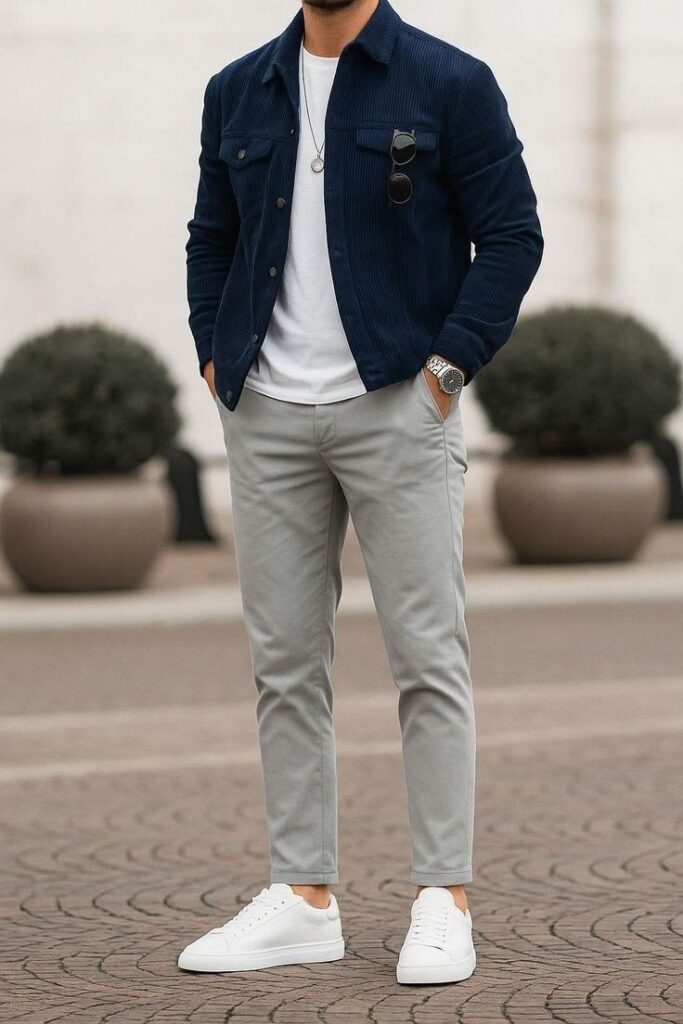

Field or trucker jacket. This is your outer layer when a shirt or overshirt isn’t enough on its own. Field jackets suit casual outfits and tend to have a slightly more rugged, utilitarian look, with patch pockets and a straight cut. Trucker jackets pair well with denim and knitwear and have a more casual, slightly boxier shape. Neither should feel heavy in the hand. If you can’t comfortably fold it over your arm for a few hours, it’s doing too much for this stage of the season.
Fine-gauge knitwear. Merino, cotton crewnecks, and fine sweaters give you warmth without adding bulk under a jacket. Skip heavy cable knits for now; they’re bulkier, harder to layer, and better suited to when it’s genuinely cold rather than just cool. Neutral colors like navy, grey, brown, cream, and charcoal get the most wear because they sit quietly under a jacket and still look intentional worn alone.
Oxford and chambray shirts. These are the easiest pieces to carry straight from summer into autumn without buying anything new. Wear one alone when it’s warm, add a sweater over it when it’s cool, and add a jacket on top when it’s cold. The heavier weave of an Oxford cloth already gives it a bit more structure than a summer shirt, so it holds up well as a base layer under other things. Chambray does the same job with a slightly more casual, worn-in look.
Denim. As summer trousers start feeling too light, dark denim becomes the easiest everyday swap. A dark indigo or black pair reads as more put-together than a faded wash and works with almost everything else on this list, from an Oxford shirt and overshirt to a sweater and jacket. Get the fit right: enough room to move without being loose, and not so slim that it looks stretched over the leg.
Leather sneakers and chukka boots. Footwear is one of the simplest ways to shift a look toward autumn without touching anything else in the outfit. Clean leather sneakers work well on warmer days and keep things looking sharp without being formal. Switch to chukkas, Chelsea boots, or a simple derby once mornings turn properly cold. All three pair naturally with dark denim or chinos and work with the rest of the pieces here.
Lightweight scarf. Just a light wool or cotton one, nothing heavy yet. It’s a small addition, but it covers the gap between “no scarf” and “winter scarf” on days when your neck is the only part of you that’s actually cold. Neutral colors like grey, navy, or camel are easiest to match to whatever jacket or overshirt you’re already wearing.
A practical bag. A tote or crossbody bag gives you somewhere to stash a scarf or jacket once you don’t need it. This matters more than it sounds like it should: the biggest reason people skip layering in autumn is that carrying a spare layer around all day feels like a hassle. A simple bag solves that problem and makes it much easier to actually follow the “add a layer, remove a layer” approach instead of just picking one outfit and sticking with it regardless of the weather.
Keep Your Summer Colors, Just Deepen Them
One of the easiest mistakes to make is thinking autumn means an entirely new color palette: head-to-toe brown, olive, and burgundy from October onward. It doesn’t, and treating it that way is usually what makes the season feel expensive.
Instead, keep the colors you already reach for and just shift them a shade darker or richer. It’s a smaller change than it sounds, but it’s often enough to make a summer outfit read as seasonally appropriate:
- White becomes cream or ecru
- Light blue becomes chambray or deeper blue
- Pastels get paired with brown, olive, navy, or charcoal instead of white or light grey
- Bright colors become accents, like a single piece, rather than the main color of the outfit
Navy still works year round. It just looks more autumnal next to dark denim, brown leather, or earthy tones like olive and rust than it does next to the pastels and whites you’d pair it with in summer. The same logic applies to most colors you already own: the color itself often doesn’t need to change, just what you put next to it.
Fabric Weight Matters as Much as Color
Sometimes the fix isn’t another layer. It’s a heavier fabric in the same piece:
- Linen to linen-cotton blend
- Thin poplin to Oxford cloth
- Lightweight chinos to heavier twill
- Summer shirt to brushed cotton or flannel
Same categories of clothing. Just heavier material.
Outfits by Occasion
The three-layer system doesn’t change from one occasion to the next, but which pieces you reach for, and how dressed up they look, does. Here’s how to apply it depending on where you’re headed.
Commute or work. Oxford shirt, dark denim, open overshirt, leather sneakers. The overshirt worn open does double duty here: it looks intentional rather than thrown on, and it’s easy to shed at your desk once the office warms up. If your workplace leans more formal, trade the denim for chinos and swap the sneakers for a derby, keeping the same shirt-and-overshirt combination as your base. The goal is a look that survives a walk or a commute in variable weather and still holds up in a meeting.
Weekend and errands. Plain T-shirt, fine-gauge sweater, midweight chinos, chukka boots, light jacket. This is the most forgiving version of the system, built for a day with no fixed schedule: grocery runs, coffee, maybe a walk. The sweater and jacket are both easy to pull off and carry if you end up somewhere warm, and chukka boots hold up better than sneakers if you’re on your feet for a few hours.
Dinner or date. Chambray shirt, unstructured blazer, dark denim, leather shoes. This is where the mid layer shifts from purely functional to doing some visual work too. An unstructured blazer reads as more put-together than an overshirt without tipping into formalwear, and it’s still light enough to take off at the table if the restaurant is warm. Drop it entirely if the evening is mild, or add a light jacket over the top for the walk there and back if it’s cold.
Casual social plans or outdoor activities. T-shirt, overshirt, dark denim or chinos, leather sneakers. Built for situations where you’ll be moving around, standing outside, or not sure exactly how the day will unfold, like watching a game, a market, or an afternoon outdoors with friends. Every piece here is easy to move in and easy to shed, which matters more than looking sharp when the plans themselves are loose.
Smart or semi-formal event. Oxford or chambray shirt, sweater, unstructured blazer, chinos or dark denim, derby shoes. This stacks three layers at once, so fit matters more here than anywhere else: each piece needs enough room to sit over the one before it without looking bulky. It gets you close to a jacket-and-tie level of polish without the formality, which works for things like a nicer work event or a family gathering where a suit would be overdoing it.
Check Your Wardrobe First
Before buying anything, ask yourself:
- Do I have a light layer for over a T-shirt?
- Do I have a sweater that fits under a jacket?
- Do I own at least one pair of darker trousers?
- Do I have a jacket for cool mornings, not just freezing ones?
- Do I have footwear beyond summer sneakers?
- Can I remove one layer and still look put together?
Mostly yes? You just need to fill a gap or two, not replace everything.
Do’s and Don’ts
Do
- Layer pieces you already own before buying anything new
- Choose an outer layer light enough to carry when you don’t need it
- Move toward heavier fabrics in the same colors and cuts you already wear
- Rotate jackets so they get time to air out
Don’t
- Rebuild your whole wardrobe for one season
- Jump straight to heavy coats and cable knits before it’s actually cold
- Wear the same jacket every single day
- Skip the “can I remove one layer” test when planning an outfit
Caring for These Pieces
- Check labels before washing wool or merino. Some need hand washing.
- Fold knitwear instead of hanging it, so it doesn’t stretch out of shape.
- Steam overshirts and jackets to remove creases instead of ironing flat.
- Rotate your jackets so the fabric gets time to air out.
FAQ
When should I start dressing for autumn? Follow the weather, not the calendar. Once mornings and evenings turn cool but afternoons are still warm, start adding light layers.
Can I still wear shorts? Yes, if it’s genuinely warm. Balance them with a heavier top and closed-toe shoes. Once it’s consistently cold, switch to trousers.
What’s the single most useful piece? An overshirt. It works as a shirt, a mid layer, or a light jacket.
How do I avoid overheating? Build outfits you can adjust. Start with your base, add layers for the morning, and take them off as it warms up.
Do I need a whole new wardrobe? No. Change fabric weights, add a few key pieces, go a shade darker with color, and update your footwear. That’s usually enough.
Bottom Line
Start with what you own. Add a few key layers: an overshirt, a heavier chino, one solid jacket. Go slightly darker with color. That’s the whole shift from summer to autumn.